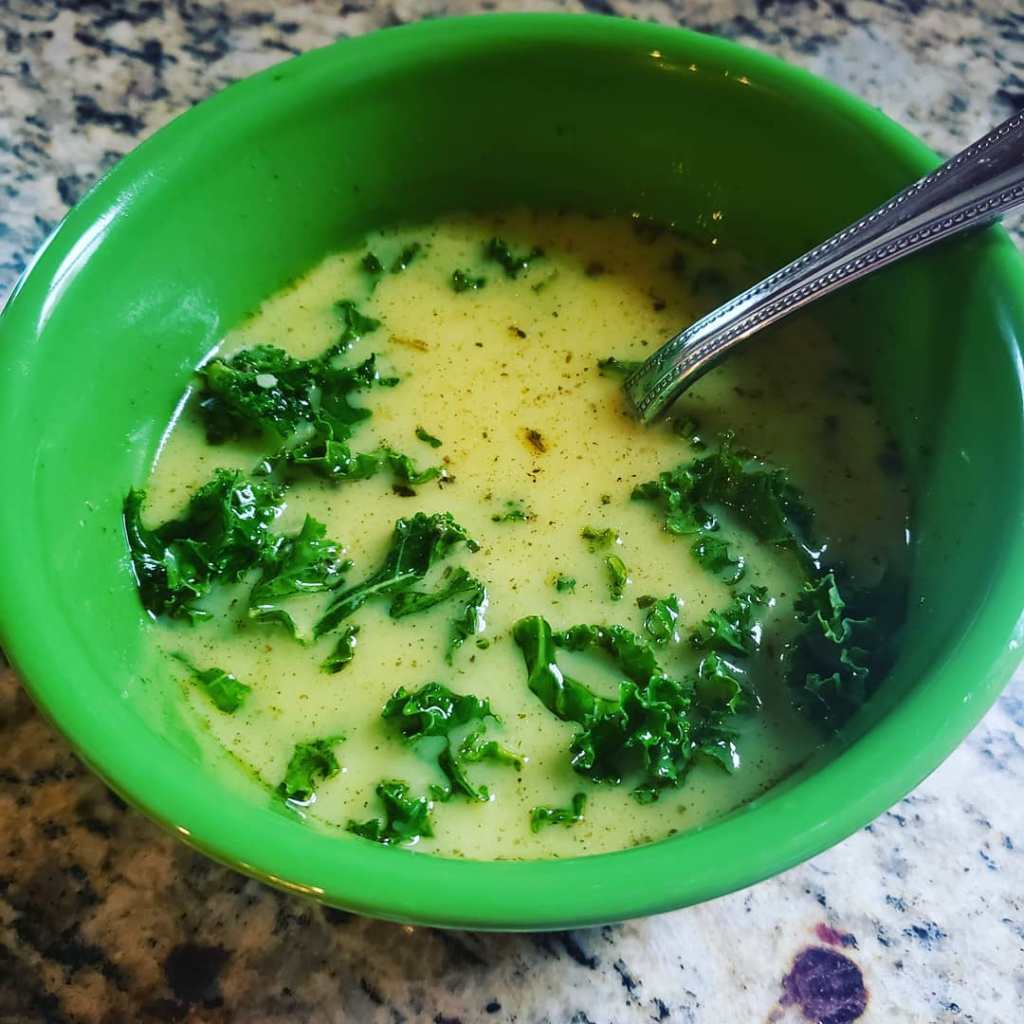
Ingredients:
- Turkey bone broth
- Cooked turkey bones
- Onion, peeled and quartered
- 4 cloves of Garlic, peeled
- Herbs (parsley, rosemary, thyme, etc.)
- Water
- 5 scoops of MCT Oil Powder
- Seasoning to taste: turmeric, garlic, basil, rosemary, sea salt, black pepper (not AIP friendly), nutmeg (not AIP friendly)
- Chopped Kale (handful or about 1/2 to 1 cup)
- 2 cloves of Garlic (chopped)
Directions:
- Turkey Bone Broth:
- Remove most of the meat from bones of cooked turkey
- Place them in crockpot, large pot, or instant pot, with onion, garlic and herbs
- Water and minimum cook times (you can always go longer):
- Instant Pot: cover with water to max fill line, cook for 2 hours, pressure cooker, high, natural pressure release
- Crockpot: cover with water to max fill line, cook for 6 hours, low
- Stove: cover contents by 2 inches of water, cook for 4-6 hours, medium-low, simmer
- Strain and discard solids
- Transfer all or some bone broth to pot on stove (you may want set some aside as a stock for other meals).
- Add in MCT oil powder and seasoning to taste.
- When ready to serve, add in kale and garlic and let sit for a few minutes to soften kale and garlic.
Health Benefits:
Turkey Bone Broth:
- Bone broth is made by simmering the bones and connective tissue of animals. Humans have been consuming bone broth since prehistoric times, enabling us to consume parts of animals and fish that are otherwise inedible.
- Animal bones are rich in calcium, magnesium, potassium, phosphorous and other minerals, which support bone health.
- Connective tissue contains glucosamine and chondroitin, which support joint health.
- Bone marrow contains Vitamins A and K2, as well as minerals, including zinc, iron, boron, manganese and selenium, and omega-3 and omega 6 fatty acids.
- Bone broth contains glutamine, which promotes the function of the intestinal walls and heals “leaky gut,” a condition in which the walls of the intestine is impaired and permits food to leak into your blood stream. Leaky gut is associated with chronic conditions and inflammation.
- Bone broth is beneficial for people suffering from leaky gut, IBS, IBD, ulcerative colitis and Crohn’s disease.
- Bone broth reduces inflammation, aids in sleep and brain function, and improves joint health.
Onions:
- Onions are considered nutrient-dense (high in nutrients, low in calories).
- They are a rich source of Vitamin C, B vitamins, including folate (B9) and pyridoxine (B6) — which aid metabolism, red blood cell production and nerve function, and potassium. Potassium is necessary for normal cell function, fluid balance, nerve transmission, kidney function, and muscle contraction.
- Onions are packed with antioxidants, help control blood sugar, are believed to boost bone density, have antibacterial properties, and aid in digestion.
Kale:
- Kale is a serious super food.
- It is loaded with nutrients, powerful antioxidants, iron, calcium, fiber and Vitamins C and K.
- Kale can help manage blood pressure, high cholesterol, digestive function, heart health, cancer, and blood sugar.
- Kale contains calcium and phosphorus, which promotes healthy bone formation. Kale also contains Vitamin K, which helps bones heal from fractures.
- Kale’s water and fiber content help with digestive regularity and prevent constipation.
- Kale is also good for the skin and hair growth because it contains beta-carotene and Vitamin A.
- Kale’s vitamins and antioxidants are good for the eyes and prevent macular degeneration.
Garlic:
- 1 clove of garlic contains:
- Manganese: 2% of the Daily Value (DV)
- Vitamin B6: 2% of the DV
- Vitamin C: 1% of the DV
- Selenium: 1% of the DV
- Fiber: 0.06 grams
- Garlic also contains calcium, copper, potassium, phosphorus, iron and vitamin B1.
- Garlic supports the immune system, reduces blood pressure, and reduces LDL cholesterol (the bad kind).
- Garlic’s antioxidant properties, combined with its effect of reducing cholesterol and blood pressure, may reduce the risk of Alzheimer’s disease and dementia.
- Garlic combats metal toxicity and improves bone health.
MCT Oil Powder:
- Medium-chain triglyceride (MCT) oil is commonly extracted from coconuts and contains medium-length chains of fats called triglycerides, which are digested more easily than longer-chain fatty acids.
- MCT oil can promote weight loss and boost energy.
- MCTs are converted to ketones when carbohydrate intake is low and ketones are an alternative energy source for the brain.
- MCT oil can optimize the growth of good bacteria in your intestines and support the gut lining.
- Studies have shown that MCT oil and a ketogenic diet can be used to manage epilepsy, Alzheimer’s disease and autism.
- MCT oil has antimicrobial and antifungal effects and contains caprylic, capric, and lauric acid, which reduce yeast and bacterial growth
- MCT oil may reduce risks associated with heart disease. It can reduce HDL cholesterol, increase LDL cholesterol, and significantly reduce C-reactive protein (CRP), an inflammatory marker that increases the risk for heart disease.
- MCT oil reduces fat storage and increases fat burning, which helps manage diabetes.
Nutmeg
- Nutmeg is rich in antioxidants, which protect cell health, reduce inflammation, and protect against chronic diseases like cancer and heart disease. It has anti-inflammatory and antibacterial properties.
- Nutmeg relieves pain, soothes digestion, improves cognitive function, detoxifies the body, promotes skin and oral health, reduces insomnia, supports the immune system, and improves blood circulation.
- Nutmeg is believed to help control blood sugar, promote heart health, and improve mood.
Sea Salt
- Sea salt is made from evaporated sea water.
- Sea salt is mostly composed of sodium chloride, which regulates fluid balance and blood pressure in the body.
- Sea salt contains trace amounts of potassium, iron and calcium.
- Salt prevents against dehydration, promotes skin health and reduces inflammation, and aids in digestion.
Turmeric
- Turmeric contains curcumin, which has powerful anti-inflammatory and antioxidant properties.
- Turmeric helps fight common brain disorders, including depression and Alzheimer’s because curcumin contains the brain hormone BDNF, which increases the growth of neurons.
- Turmeric protects against heart disease. Curcumin boosts the function of the lining of blood vessels, the endothelium.
- Studies suggest turmeric may prevent cancer and reduce cancer cell growth.
- Turmeric aids in the treatment of Alzheimer’s Disease, cancer
 Honey and Ghee